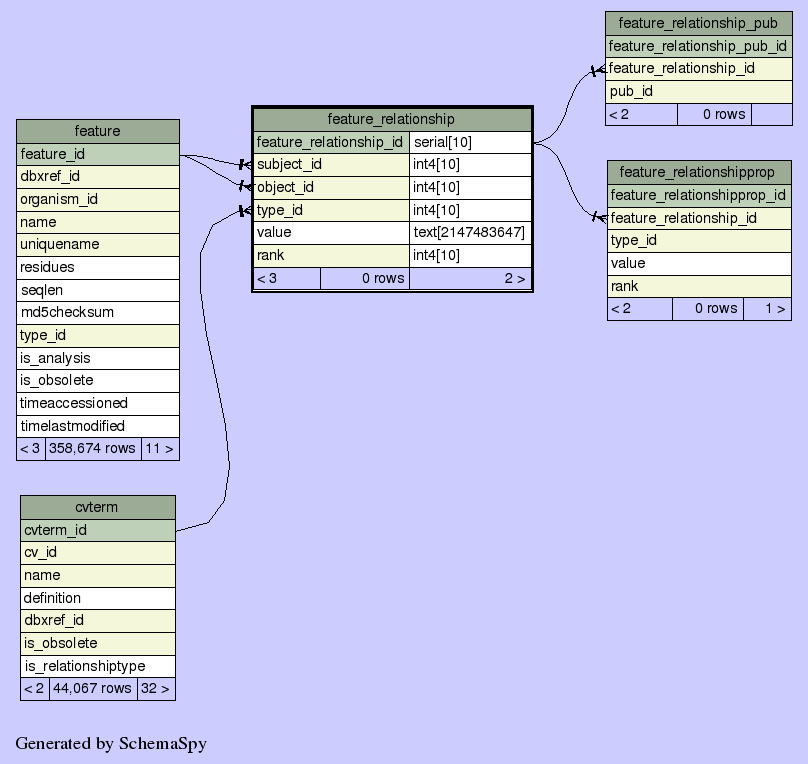
Table cxgn.public.feature_relationship

features can be arranged in
graphs, eg exon part_of transcript part_of gene; translation madeby
transcript if type is thought of as a verb, each arc makes a statement
[SUBJECT VERB OBJECT] object can also be thought of as parent
(containing feature), and subject as child (contained feature or
subfeature) -- we include the relationship rank/order, because even
though most of the time we can order things implicitly by sequence
coordinates, we cant always do this - eg transpliced genes.  its also
useful for quickly getting implicit introns

Generated by
SchemaSpy
Related columns Constraint names Comments Legend
Legend: SourceForge.net
Primary key columns
Columns with indexes
Implied relationships
Excluded column relationships
Dashed lines show
implied relationships
< n > number of related tables
Please support this project 
Column Type Size Nulls Auto Default Children Parents Comments
feature_relationship_id serial 10  √  nextval('feature_relationship_feature_relationship_id_seq'::regclass)
feature_relationship_pub.feature_relationship_id feature_relationship_pub_feature_relationship_id_fkey
feature_relationshipprop.feature_relationship_id feature_relationshipprop_feature_relationship_id_fkey
subject_id int4 10
feature.feature_id feature_relationship_subject_id_fkey
the subject of the subj-predicate-obj sentence. This is typically the subfeature
object_id int4 10
feature.feature_id feature_relationship_object_id_fkey
the object of the subj-predicate-obj sentence. This is typically the container feature
type_id int4 10
cvterm.cvterm_id feature_relationship_type_id_fkey
relationship type between subject and object. This is a cvterm, typically from the OBO relationship ontology, although other relationship types are allowed. The most common relationship type is OBO_REL:part_of. Valid relationship types are constrained by the Sequence Ontology
value text 2147483647  √  null Additional notes/comments
rank int4 10 0 The ordering of subject features with respect to the object feature may be important (for example, exon ordering on a transcript - not always derivable if you take trans spliced genes into consideration). rank is used to order these; starts from zero

Table contained 0 rows at Wed May 20 01:40 EDT 2009

Indexes:
Column(s) Type Sort Constraint Name
feature_relationship_id Primary key Asc feature_relationship_pkey
subject_id + object_id + type_id + rank Must be unique Asc/Asc/Asc/Asc feature_relationship_c1
subject_id Performance Asc feature_relationship_idx1
object_id Performance Asc feature_relationship_idx2
type_id Performance Asc feature_relationship_idx3

Close relationships  within one two degrees of separation :